
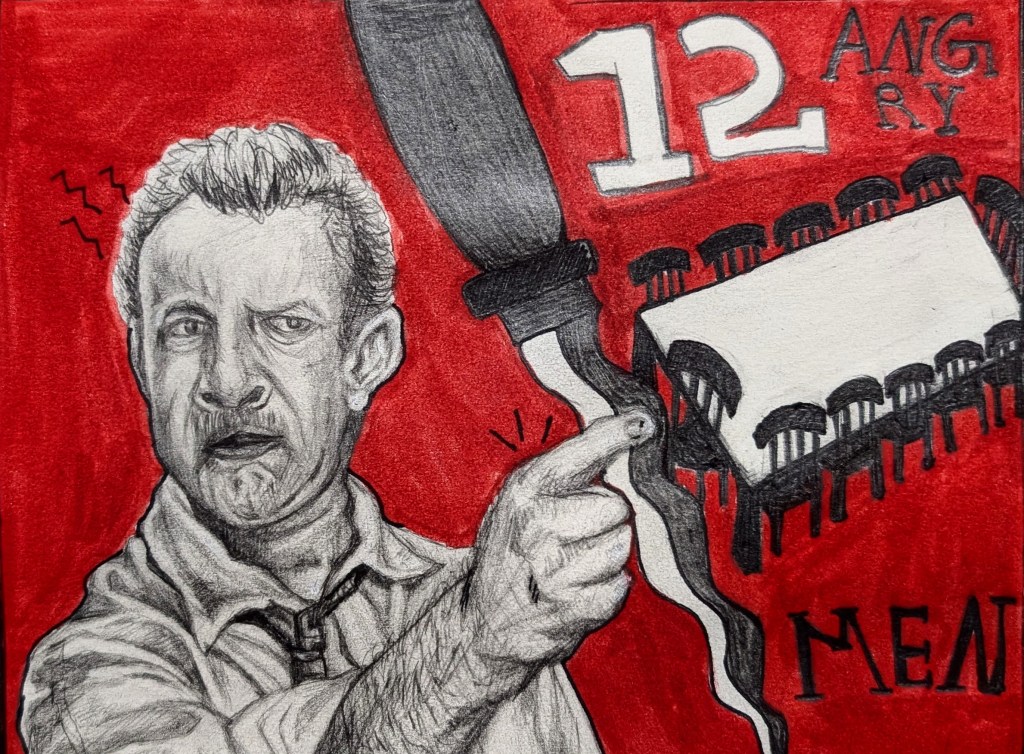
12 Angry Men is one of, if not the, greatest movie of the 1950’s. The film’s writing was exceptional for its time, and paired with the cinematography, it quickly became a timeless classic. The cleverness of the writing and the engaging dialogue quickly helped it become nominated at the Academy Awards (Oscars) three times, reach a 4.5-star rating, and even achieve the win at the Berlin International Film Festival. This movie is recognizable from the many who have taken law in grade 11; however, it is more than just an assignment; it is a masterpiece that discusses the corruption of the American Justice System and how the action of one individual can cause change.
The film begins in a courthouse, where we are introduced to the main characters and plot of the movie. 12 jurors need to decide the fate of a single man accused of first-degree murder. If found guilty, the man will be harshly sentenced. The quote “in the event that you find the accused guilty, the bench will not entertain a recommendation for mercy” exemplifies the seriousness of the situation, and what the judge states sets the mood for the rest of the film.
As the 12 jurors enter the jury room, we are introduced to their personalities through their interactions, which makes the movie feel more immersive and real. Additionally, the movie hints at their personalities with their suits. The characters’ appearances subtly reflect their personalities. or what kind of person one is perceived to be. Whether this is through pattern, shape, or design, it provides individuals with subtle cues of what kind of person they may be. In this case, the different designs of the suits and ties reflect the personality of each character, where the ones with blander choices of suits are more mature and serious characters, while the expressive and designful suits reflect more humorous and non-serious personalities.
THE VOTES BEGIN…
Finally, the discussion begins, and each character sits at a long table, casting their votes. The law in America states that every juror needs to vote either guilty or not guilty and the 12 members of the jury must be unanimous in their decision for it to be a successful vote, which is where our main conflict starts. Out of the twelve men, eleven vote guilty, and one votes not guilty, which means that it is not a successful vote, and because of this, a discussion must take place. The odd-one-out, juror #8, played by Henry Fonda, starts debating with the other eleven men about his decision, showing a more empathetic approach to the decision, which is shown through the quote: “This boy’s been kicked around all his life. living in a slum, his mother has been dead since he was nine. He spent a year and a half in an orphanage while his father served a jail term for forgery. That’s not a very good headstart.” This puts a new perspective on the men, who immediately decided that he was guilty without a second thought. This reflects the corruption of the American justice system, since all eleven men immediately decided that the boy was guilty, one even saying that he wants to go home as soon as possible, not caring about the case nor the fate of the boy, whether he gets executed or not. The juror system in the 1950’s was very flimsy, and discrimination was a common theme amongst jurors. Immediate assumptions based on skin colour or ethnicity would be made very often, and it led to many deaths. A real-life example of this was with a boy of the name George Stinny. He was only 14 years old when he was executed as a result of an unfair trial about two first-degree murders of two girls. This happened in June of 1944, and after a re-examination of the case years later, it was concluded that he wasn’t guilty. He was unfairly given the death sentence because of his skin colour, since he was a black male, and this case highlights the prejudice of the American legal system back then.
After their argument, Juror #8 proposes another vote; however, it would be under the conditions of a secret ballot. If everybody else votes guilty, then he will agree to vote guilty.. However, as the foreman reads out the votes, one man votes not guilty, making the vote 10 to 2, and sparking another discussion. This showcases how the action of one individual can change the perspective of many. A real-life example of this is protesting. One protestor can turn into many if they are able to change the perspective and beliefs of others. Additionally, one strong voice is far better than multiple weak ones, which is what makes this protagonist so powerful.
Throughout the movie, vote after vote, more and more people vote not guilty as our protagonist debunks more testimonies and comes up with possibilities that make the outcome of the case even clearer, convincing even the people who possess more firm beliefs about the situation, like Juror #3.
At the end of the movie, when everyone is convinced, the room slowly empties as all of the men leave. We are left with a heartwarming scene of Juror #8 giving Juror #3 his jacket, which represents settling their differences and coming to a solution that they both believe in, despite their contrasting beliefs. The silence in that scene let us reflect on the ending and how one decision from one man changed the course of the entire movie. In all, the movie does a great job in expressing the message of “Don’t be a sheep” and to be entitled to your own opinions, since it can bring forth new perspectives in others, and in this case, save a man’s life.
Image Credits: Himanshi




 THE NORTH STAR