
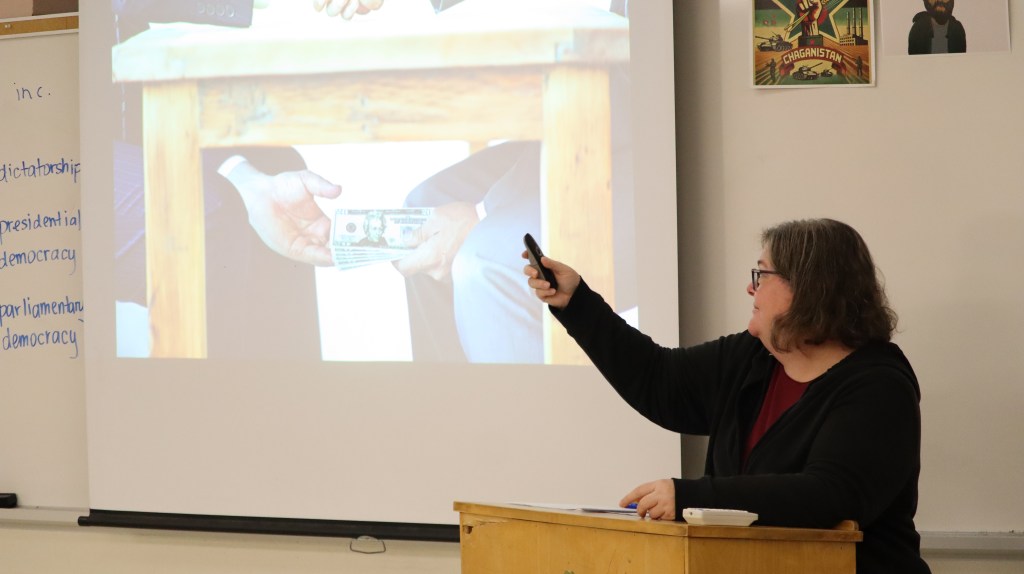
While grade 10s in the Peel District School Board spend their civics classes memorizing the three branches of government, the real civics lesson is happening right outside the classroom. You don’t need a textbook to see how power actually works in the world. Students learn the “official” process of how a bill becomes law, yet the curriculum tiptoes around the part where influence is traded like a currency.
The CHV2O course gives us a polished diagram of what democracy should look like. It teaches that good ideas rise to the top because people debate, vote, and choose wisely. But recent events in this world make something very clear: in real life, the ideas that rise are often the ones backed by a rich white guy. This dynamic makes true democracy impossible, basically replacing it with an oligarchy where the wealthy own the system. According to Democracy Watch co-founder Duff Conacher, the unchecked flow of private money into public politics severs the bond between representatives and their constituents. When politicians depend on corporate donations to survive, they are forced to serve their investors rather than the voters, turning the ballot box into a marketplace where justice goes to the highest bidder, and the average citizen is left powerless.
“Democratic societies require more than citizens who are fact-full,” said Joel Westheimer, a University of Ottawa professor who studies how we teach civics. “They require citizens who can think and act in ethically thoughtful ways.” His point is sharp. Our current approach encourages “personally responsible” citizens who follow the rules, but not those who ask who wrote the rules and who benefits from them. We’re told to memorise the steps of parliamentary procedure, but never to question the system itself.
Our textbooks explain how a bill is introduced. They do not explain how lobbyists book steakhouse dinners with the people writing them. They do not explain how campaign donations create invisible pulls around policy. They do not explain why certain voices carry farther than others.
Westheimer puts it bluntly: “If the people are not well educated enough to govern their own affairs, then the solution is not to take that power of governance away from them but to educate them.” Right now, that education is falling short. Civics, shoved into nine weeks as a half-credit, skims past the “Revolving Door” between government and industry, as if that revolving door doesn’t shape half the decisions that affect our lives.
The students aren’t clueless. They can see the infrastructure falling apart. They can feel the cost of living rising fast. They hear the boomers talk about how “the system works,” while watching it clearly not work for a lot of people.
If Peel truly wants to create engaged citizens, the curriculum can’t just teach the “how” of government. It has to teach the “who” and the “why.” Who is influencing decisions behind the scenes? Why are certain interests protected while others are ignored? Until schools start teaching students to follow the money, civics will keep preparing us for a version of democracy that exists only in theory. It’s time to stop the mythology of a perfect system and start teaching students to understand the world as it actually is: flawed, complicated, and desperately in need of revolutionary change.


 THE NORTH STAR